Australian Engineers Develop Low-Carbon Building Material Using Cardboard And Soil
 April Ossington
08 Jan 2026
April Ossington
08 Jan 2026
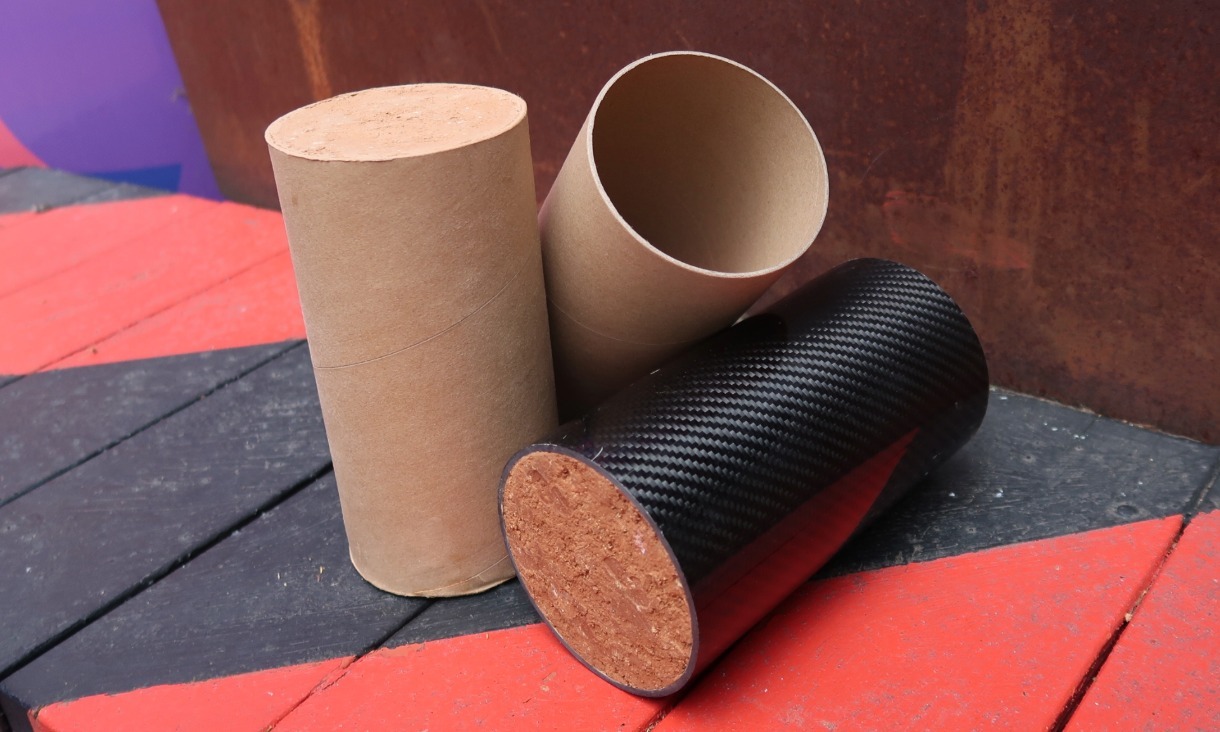
Engineers in Australia have created a new construction material that could significantly reduce emissions from the building sector while cutting waste sent to landfill. Known as cardboard-confined rammed earth, the material uses only cardboard, soil and water and produces roughly one quarter of the carbon footprint of traditional concrete.
The development comes as Australia sends more than 2.2 million tonnes of cardboard and paper to landfill each year, while cement and concrete production are responsible for around 8 per cent of global annual emissions. By repurposing cardboard as a structural component rather than waste, the researchers believe the approach could address both problems at once.
Cardboard has previously appeared in architecture, particularly in temporary structures and disaster relief projects such as Shigeru Ban’s Cardboard Cathedral in Christchurch. Drawing inspiration from these concepts, a research team at RMIT University has, for the first time, combined cardboard with the long-standing technique of rammed earth construction to create a more durable and permanent building solution.
Lead author Dr Jiaming Ma from RMIT said the innovation represents an important step towards a more sustainable construction industry. He explained that modern rammed earth walls often rely on added cement to achieve the required strength, despite their natural thickness already providing significant structural support. Removing cement from the process dramatically reduces environmental impact.
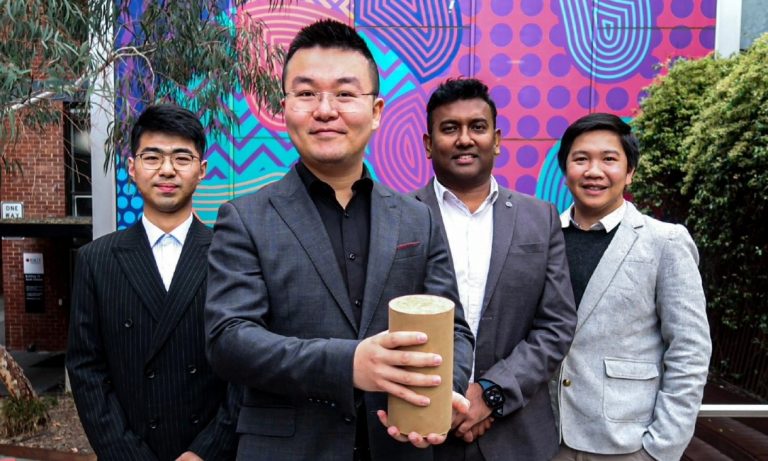
The RMIT-based research team. L–R: Hongru Zhang, Jiaming Ma, Dilan Robert and Ngoc San Ha
According to the research team, cardboard-confined rammed earth eliminates the need for cement entirely and can be produced at under one third of the cost of concrete, while generating only around 25 per cent of its carbon footprint. Dr Ma said walls built using the new method are strong enough to support low-rise buildings and can be made almost entirely from locally sourced materials.
The material is formed directly on site by compacting a soil and water mixture inside cardboard formwork, either by hand or using machinery. Once compacted, the cardboard remains in place, confining the rammed earth and contributing to its overall strength. Because the components are simple and lightweight, transport requirements are significantly reduced.
Study co-author Emeritus Professor Yi Min ‘Mike’ Xie said the approach could lead to a leaner and greener construction process. Instead of transporting heavy loads of bricks, steel and concrete, builders would only need to bring cardboard to the site, with most other materials sourced locally. This could reduce transport costs, simplify logistics and lower upfront material demands.
The researchers believe the system could be particularly useful in remote and regional parts of Australia, where suitable soils for rammed earth construction are abundant. Rammed earth buildings are well suited to hot climates due to their high thermal mass, which helps regulate indoor temperature and humidity. This natural climate control can reduce reliance on mechanical cooling and further cut carbon emissions over a building’s lifetime.
The strength of cardboard-confined rammed earth varies depending on the thickness of the cardboard tubes used in construction. Dr Ma said the team has developed a method to calculate and predict this strength, allowing designers to tailor the material to specific structural requirements. In related research, the team has also explored combining rammed earth with carbon fibre, achieving strength levels comparable to high-performance concrete.
Together, these findings suggest earth-based construction could play a growing role in the push towards lower-emission building practices, particularly as the industry searches for practical ways to meet net zero targets using simple, recyclable and locally available materials.